
So why do bladder problems happen at all? Most of us write them off as the toll of getting older. At Jude, we don't see it that way. We see it not as an age problem, it is a muscle matter.
Your bladder, far from the passive little sac we all imagine, is a muscle.Your pelvic floor is a sling of muscle too.
See it that way, and everything you'd assumed was inevitable starts to look a great deal more fixable, and a great deal less embarrassing.
You have two different muscle groups down there, and they're not the same
Your bladder wall is built from muscle called the detrusor², and it's the one that decides when you go: it stretches as you fill, and squeezes to empty.
Your pelvic floor is muscle too (in fact it is a group of more than a dozen muscles working together)³, think of it as a hammock with a tap, holding everything in place while letting you hold on, and let go, on your terms.
Here's the part almost no one explains: these two contain mostly entirely different kinds of muscle. Your pelvic floor answers to you, the way your bicep does, which is exactly why you're told to train it with exercises.
Your bladder muscle is smooth muscle. It runs on involuntary signals, working away on its own whether you like it or not. And that single distinction decides which problem you actually have.
So which muscle has gone wrong?
If your days are ruled by the sudden, can't-wait need to go, and going far more often than seems reasonable, the trouble is most likely your bladder muscle called detrusor overactivity.
If instead you leak when you laugh, sneeze, cough or lift, that's the signature of a pelvic floor that's lost its strength
Sometimes, maddeningly, both are at fault at once. But naming the right muscle is the whole game: it's the difference between managing your symptoms forever and finally targeting the root.
If you’re experiencing a new symptom, remember, your doctor or healthcare professional can help you understand what’s going on, reach an accurate diagnosis, and provide the support and treatment that’s tailored to your needs.
When it's the bladder muscle
Because the bladder muscle runs on involuntary signals, many women who do their Kegels/ pelvic floor exercises faithfully see very small changes. Three things happen to the bladder muscle over the years:
It loses its resilience and stretch, so it simply holds less.
Its nerves begin to misfire, wrong timing, wrong place, and suddenly you're scanning every room for the nearest loo.
It grows more sensitive, until the morning coffee you handled for years now irritates it enough to set off a reaction.
None of that responds to typical exercise. But you can train your bladder through a bladder re-training programme which re-wires the bladder-brain connection and by avoiding bladder irritants.
Retraining leans hard on willpower. Precisely because 75% of your bladder is a muscle, one that cannot be trained with typical exercises, one needs to find another way to support muscle function from within. Our bladder responds to what we eat, think how quickly caffeine, alcohol or acidic foods can set it off.
If it reacts to the irritants, the reverse holds just as true: your bladder also responds to the right types of food. It responds to nutrients, and especially to the ones your body simply makes less of as the years go on.
Which is why topping those nutrients back up matters. Give the muscle what it needs, and you're supporting the function, coordination and control that hold everything steady.
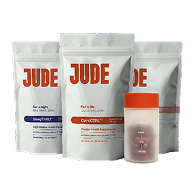
BLADDER HEALTH SUPPLEMENT
Take back control of your day
 Supports you to only go when you need toHold for longer between bathroom visits.77% of women felt more in control after 12 weeks
When it's the pelvic floor
The pelvic floor tells a different story. Pregnancy and birth stretch and strain it. Gravity, heavy lifting and even coughing and sneezing presses down, year after year. And a lifetime of ordinary pressure wears at a muscle that was never built to hold the line forever. But there's more to it than a tired muscle:
Collagen, the key building block of the pelvic floor, and studies have shown that in skin Type I collagen especially, slows by around 1% a year from your mid-twenties, and drops more sharply through menopause.⁴
The good news? Unlike the bladder, this one you can exercise and rebuild through pelvic floor exercises. But like any muscle, it only rebuilds with the right raw materials behind it.
And oestrogen speeds up both
Then perimenopause arrives and accelerates the pair of them at once. The tissues of both the bladder and the pelvic floor are dense with oestrogen receptors, so as oestrogen falls away, decline picks up pace on both fronts. It's why so many women feel it all converge in their forties, the urgency that appears from nowhere, and a post-baby pelvic floor that suddenly feels weaker than it did a year ago. It's also why bladder issues can spike in our mid-forties, exactly as oestrogen begins its decline.
The building blocks each muscle needs
Your bladder muscle needs feeding in the same three places that let it down:
For muscle and tone: pumpkin seed extract, an excellent plant-based source of L-Arginine, is long associated with bladder health, alongside magnesium, which contributes to normal muscle function.
For healthy nerves: magnesium again, with B vitamins such as B6 and B12, which support your nervous system, making you feel more coordinated
For a bladder grown over-sensitive: soy germ isoflavones, gentle plant compounds that echo the body's own oestrogen, which may help support the more delicate tissue as levels fall.
Your pelvic floor needs a different toolkit:
To support rebuilding the muscle itself: amino acids to supply the raw material, with vitamin D and magnesium for normal muscle function.
To support collagen in the pelvic floor: soy germ isoflavones, gentle plant compounds that echo the body's own oestrogen, which may help support collagen formation in pelvic floor muscles.⁵
Two problems. Two answers.
Our Bladder Health Supplement is made for the muscle you can't exercise in the traditional way, plant-based nutrition to nourish and support the muscle behind bladder control. So you can feel hold more, for longer.
Take our quiz, tell us what you're really feeling, and we'll point you to the muscle that needs you, and the one thing that will help.
2 min quiz
Not sure which supplement is right for you?
Answer a few questions about your symptomsTrusted by 150,000+ womenFewer urgent trips to the bathroomTHE SUNDAY SUPPLEMENT
Bladder care, in your inbox
Join our newsletter for tips and tricks to life's trickly moments.
Feel secure all day long with our range of bladder care products. The entire range has been created with our team of experts and community of real women.
No spam. Unsubscribe anytime.