
Unlike the muscles in your arms, legs or even your pelvic floor, the bladder is made up of smooth muscle, controlled largely by your nervous system rather than by conscious movement.
This might come as a surprise to you because we're often told to "strengthen our bladder" when leaks or urgency appear. But biologically, that's not really what's happening. In most cases, improving bladder health is about supporting the systems around the bladder, rather than the bladder muscle itself.
"I thought I just had a weak bladder."
This is one of the most common ways women describe bladder symptoms. Maybe you leak when you laugh or exercise. Perhaps you can't make it to the toilet without crossing your legs, or you feel like you need to wee every hour. Whatever the symptom, it's easy to assume your bladder has simply become "weak".
But a "weak bladder" isn't a medical diagnosis. In fact, it can describe several completely different conditions, including stress urinary incontinence, overactive bladder, urinary urgency and even bladder symptoms linked to menopause.
That's why understanding why you're experiencing symptoms is far more useful than simply trying to make your bladder "stronger".
Your bladder isn't your pelvic floor
One reason the phrase "strengthen your bladder" causes so much confusion is because the bladder and pelvic floor are often treated as though they're the same thing. They're not.
The bladder is an organ that stores urine. Its wall contains the detrusor muscle, which stretches as the bladder fills and contracts when it's time to empty. This happens automatically, coordinated by your brain and nervous system.
Your pelvic floor is a sling of muscles that supports the bladder, bowel and, in women, the uterus. These muscles also help keep urine in when pressure inside your abdomen increases, such as when you cough, sneeze, laugh, run or lift something heavy.
Unlike the bladder, the pelvic floor is under voluntary control, which means it can be strengthened through exercise when appropriate.
"I've been doing Kegels, so why am I still leaking?"
This is another common misconception. Pelvic floor exercises can be incredibly effective for women with stress urinary incontinence, and NICE recommends supervised pelvic floor muscle training as a first-line treatment. But stronger doesn't always mean better.
Your pelvic floor also needs to relax, respond quickly and coordinate with the rest of your body. Some women have pelvic floor muscles that are overactive rather than weak, while others have bladder symptoms that have very little to do with pelvic floor strength in the first place.
If you've been doing Kegels for months without noticing much difference, it doesn't necessarily mean you're doing them badly. It may simply mean they aren't addressing the cause of your symptoms – but there are many other ways to nurture your pelvic floor, such as Jude’s Strength Method.
What if urgency is your biggest problem?
If your biggest challenge is desperately needing the toilet, rather than leaking when you move, the approach is often different.
Rather than strengthening muscles, healthcare professionals may recommend bladder training. This involves gradually increasing the time between feeling the urge to wee and emptying your bladder, helping retrain the communication between your bladder and brain.
It isn't about making the bladder muscle stronger. It's about helping the bladder become less sensitive to signals telling it to empty before it's actually full.
There's more to bladder health than muscles
Bladder health depends on much more than strength alone:
Hormones help maintain healthy tissues throughout the bladder and urinary tract.
Your nervous system coordinates filling and emptying.
Hydration affects how concentrated your urine becomes, while constipation, diet, physical activity and some medications can all influence bladder symptoms.
That's why there isn't one universal solution that works for everyone. Two women with exactly the same symptoms may need completely different treatments depending on what's driving them.
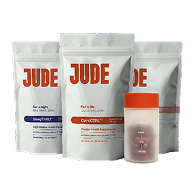
Bladder training, pelvic floor rehabilitation or medical treatment are all important, but can be supported with lifestyle changes, and supplementation – like Jude’s CoreCTRL™ or PelviTONE™ – can nurture the systems we rely on for control and support everyday bladder health and help you to regain confidence in your bladder health.
It isn’t your bladder that needs strengthening
The surprising truth about strengthening your bladder is that it usually isn't your bladder that needs strengthening. Sometimes the answer is your pelvic floor. Sometimes it's retraining the way your bladder and brain communicate. Sometimes hormones, lifestyle or another underlying condition are part of the picture.
The important thing isn't finding a way to make your bladder "stronger". It's understanding what's causing your symptoms in the first place. Because once you know that, you're much more likely to find an approach that actually works.
2 min quiz
Not sure which supplement is right for you?
 Answer a few questions about your symptomsTrusted by 150,000+ womenFewer urgent trips to the bathroom
THE SUNDAY SUPPLEMENT
Bladder care, in your inbox
Join our newsletter for tips and tricks to life's trickly moments.
Feel secure all day long with our range of bladder care products. The entire range has been created with our team of experts and community of real women.
No spam. Unsubscribe anytime.