
I'm Dr Zena Wehbe, chief scientist at Jude.
My job is formulating the products you use, running our clinical trials, and — this week — filing a patent I'm genuinely excited about (International Patent Application No. PCT/EP2026/077755). It covers something we found about grape seed extract and the muscle your pelvic floor is made of, for the first time.
What we found in the lab
Working with Professor Yousif Shamsaldeen's lab at Liverpool John Moores University, we treated pelvic floor muscle cells with Jude's grape seed extract and measured how much slow-twitch myosin they produced, compared with untreated cells. The treated cells made 3.6 times more, in just four hours — a difference that was statistically significant (P = 0.036).
Why this matters for your pelvic floor
Your pelvic floor isn't built like a sprinting muscle. It's mostly slow-twitch fibre, the kind designed to hold steady all day, not fire in short bursts, because it's doing quiet, constant work: keeping things sealed while you sit, stand, laugh or cough. Myosin is the engine protein inside that fibre; it's what actually generates the pull. More of it generally means more capacity to contract and hold.
That's what made the lab result interesting to us.
What weakens these fibres in the first place
Pelvic floor fibres don't stay constant throughout life. A few things tend to affect them:
Age — like other muscles, the pelvic floor can gradually lose fibre density and tone over the years.
Childbirth — vaginal delivery can stretch and weaken the pelvic floor, and recovery varies a lot from person to person. A British Journal of Surgery study found pelvic connective tissue resilience drops significantly after vaginal delivery, as well as with menopause and age.
Menopause — falling oestrogen is thought to affect the strength and elasticity of pelvic floor tissue, which is part of why symptoms often change around this time. A 2025 review lays out how oestrogen supports collagen and elastin production in pelvic floor connective tissue, and what happens to that tissue as oestrogen falls.
Inactivity — as with any muscle, fibres that aren't regularly worked tend to lose condition. Regular pelvic floor muscle training has been linked to lower myostatin levels (a protein that limits muscle growth) alongside improved continence.
None of this is about blame. Iit's just biology, and it's exactly why the muscle can generally be trained back up with the right, consistent input.
Where this fits into PelviTONE
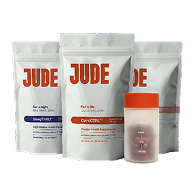
This is also the extra layer behind PelviTONE, alongside Jude's Strength Method — it's part of what makes the formulation more considered than "just another supplement," and why people following the full routine tend to feel they're getting more out of it.
Pelvic Floor Strength Supplement
Move, laugh, and live without worry.
 Feel reassured during physical exerciseProvides targeted nutrients that work alongside your exercisesSupports your muscles as your body changes
What this research is, and isn't
I want to be straightforward about this, because it matters to me as a scientist as much as it does to you as a reader. This is a laboratory finding in isolated pelvic floor muscle, so it tells us grape seed extract can switch on more myosin production. Food supplements aren't a substitute for a varied diet or for the exercises themselves.
If you're dealing with ongoing bladder leaks, heaviness, or pelvic floor symptoms that aren't shifting with lifestyle changes, it's always worth having a chat with your GP or a pelvic health physio as they can check what's actually going on for you.

2 min quiz
Not sure which supplement is right for you?
 Answer a few questions about your symptomsTrusted by 150,000+ womenFewer urgent trips to the bathroom
THE SUNDAY SUPPLEMENT
Bladder care, in your inbox
Join our newsletter for tips and tricks to life's trickly moments.
Feel secure all day long with our range of bladder care products. The entire range has been created with our team of experts and community of real women.
No spam. Unsubscribe anytime.